


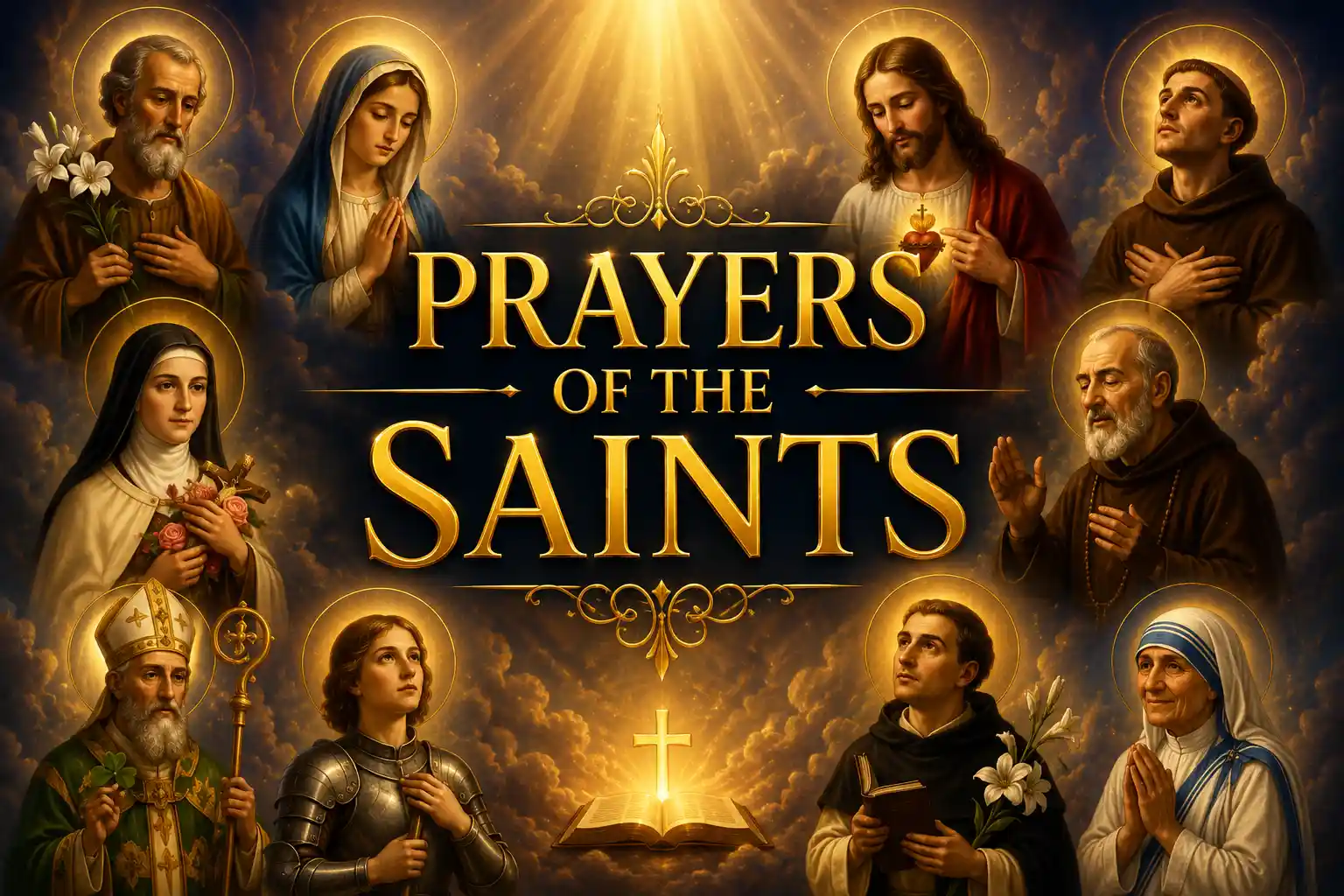
There is a phrase that appears in one of the most extraordinary visions in all of scripture — a phrase so dense with meaning that entire theological traditions have been shaped by its interpretation. The phrase is “prayers of the saints.” It appears in Revelation 5:8 and again in Revelation 8:3-4 — and what it describes is both humbling and extraordinary: the prayers of God’s people, gathered as incense, rising before the throne of the Living God and being offered before Him by angels and heavenly beings.
I have spent years studying liturgical prayer, patristic theology, and the rich tradition of Christian devotion across Catholic, Orthodox, and Protestant traditions. What I have found is this: the prayers of the saints — both in the biblical sense and in the historical sense of the prayers actually prayed by those the Church calls holy — are among the most powerful, most beautiful, and most instructive words in all of Christian heritage.
This comprehensive guide covers both dimensions: what the Bible means by “prayers of the saints,” and the actual, historical prayers of the most celebrated saints in Christian history. Whether you are Catholic, Orthodox, Protestant, or simply curious — these words were prayed by people who knew God intimately, and they carry that intimacy in every line.
What Are “The Prayers of the Saints”? The Biblical Meaning
Revelation 5:8 — The Golden Bowls of Incense
The phrase “prayers of the saints” appears first in Revelation 5:8:
“And when he had taken the scroll, the four living creatures and the twenty-four elders fell down before the Lamb. Each one had a harp, and they were holding golden bowls full of incense, which are the prayers of the saints.”
This is one of the most awe-inspiring verses in all of scripture. John is given a vision of heaven — of the throne room of God — and what he sees there, among the most sacred elements of heavenly worship, are bowls filled with the prayers of God’s people on earth. The prayers of the saints are not lost when they are prayed. They are gathered. They are preserved. They rise as incense before God in His throne room.
Revelation 8:3-4 — Prayers Rising as Incense
The second appearance is equally powerful:
“Another angel, who had a golden censer, came and stood at the altar. He was given much incense to offer, with the prayers of all God’s people, on the golden altar in front of the throne. The smoke of the incense, together with the prayers of God’s people, went up before God from the angel’s hand.”
Here the picture is even more explicit. An angel with a golden censer. The prayers of God’s people mixed with incense. Both rising — together — before the throne of God. No prayer prayed in faith is wasted. No petition offered to God dissolves into silence. They rise. They gather. They stand before God.
Who Are “The Saints” in These Passages?
The word “saints” (Greek: hagios, meaning “holy ones”) is used throughout the New Testament to refer to all believers — not just those formally canonized by a church. Out of the fifty-nine times the term “saints” is used in the New Testament, only once does it refer to Christians in heaven. All the other times it is used to refer to Christians on earth.
This means the “prayers of the saints” in Revelation includes — at minimum — the prayers of all faithful Christians on earth. Every prayer you have prayed. Every prayer prayed by your grandmother, your pastor, your church community. All of it is gathered before God as incense.
Catholic and Orthodox theology extend this understanding to include the prayers of those already in heaven — the Church Triumphant interceding alongside the Church Militant. In Revelation 5:8, John depicts the saints in heaven offering our prayers to God under the form of golden bowls full of incense, which are the prayers of the saints. If the saints in heaven are offering our prayers to God, then they must be aware of our prayers.
Protestant theology generally understands the passage to refer to the prayers of all believers — living and glorified together in God’s presence — without the specific Catholic understanding of active intercession by the deceased.
Both traditions agree on the central truth: the prayers of God’s people matter to God. They are not scattered. They are held. They rise before Him. He hears them.
The Old Testament Foundation — Psalm 141:2

The image of prayer as incense rising before God is not unique to Revelation. The Psalmist prayed:
“May my prayer be set before you like incense; may the lifting up of my hands be like the evening sacrifice.” — Psalm 141:2
If the Bible describes prayers being offered in heaven under the form of incense, and the Bible explicitly refers to prayers from on earth arising to God as incense, then we have biblical grounds for numbering the prayers of Christians on earth with the “prayers of the saints.”
The theology of the whole Bible is consistent: prayer rises. It reaches God. It is received. It matters. Explore more prayers for good luck.
What This Means for Your Prayer Life
Understanding the “prayers of the saints” should fundamentally change how you pray.
Your prayer is not shouted into the void. It is not a spiritual exercise that may or may not reach its intended destination. According to Revelation 5:8 and 8:3-4, your prayer — the words you spoke this morning, the petition you whispered last night, the desperate prayer you prayed in the darkest moment of the most difficult season — is gathered in golden bowls before the throne of God.
This is not metaphor for mere theological effect. This is the revealed reality of what happens to prayer. It rises. It is held. It stands before God.
James 5:16 adds: “The prayer of a righteous person is powerful and effective.” The prayer of a saint — a holy one, a person of faith — carries power. Not because of the eloquence of the words or the position of the pray-er but because of the God to whom it rises.
The Saints as Intercessors — The Catholic and Orthodox Doctrine

The Catholic and Orthodox churches teach that the saints in heaven continue to intercede for those on earth — that death does not end the communion of prayer among God’s people but rather perfects it.
James says: “Therefore confess your sins to one another, and pray for one another, that you may be healed. The prayer of a righteous man has great power in its effects.” James 5:16-17. According to Scripture, God wants us to pray for one another. This must mean that prayer for one another cannot detract from the role of Jesus Christ as our one mediator with God.
The Catholic position, explained carefully, is not that the saints replace Christ as mediator. It is that the saints participate in His mediation — just as any Christian who prays for another person participates in Christ’s intercessory work without replacing it. Because Jesus Christ is the one mediator before God, we can be subordinate mediators. Jesus is the reason. The Catholic position gives Jesus the most glory. He does it all but loves us so much He desires our participation.
The Protestant tradition, while rejecting the Catholic doctrine of intercession by the departed saints, fully affirms the concept of the communion of saints — the shared life of prayer among all believers across time — and agrees that the prayers of righteous people carry extraordinary power.
What all traditions share is this: the prayers of those who have walked closely with God carry a particular weight and wisdom. Whether those prayers were prayed centuries ago in a monastery or last Sunday in a living room — they rise as incense. They matter. They reach God. Check out prayers for good weather here.
Famous Prayers of the Saints — The Greatest Prayers in Christian History

What follows are the actual prayers prayed by the most celebrated saints in Christian history — men and women who walked so closely with God that their words have shaped the prayer lives of millions across hundreds of years. These are not approximations or paraphrases. These are the prayers they prayed — translated and transmitted through centuries for exactly this purpose: that we might pray them too.
The Prayer of St. Francis of Assisi
St. Francis of Assisi (1181-1226) is among the most beloved saints in Christian history — founder of the Franciscan order, lover of creation, embodiment of Gospel poverty and joy. This prayer, attributed to him, is arguably the most famous Christian prayer outside of the Lord’s Prayer itself.
Lord, make me an instrument of Your peace. Where there is hatred, let me sow love; where there is injury, pardon; where there is doubt, faith; where there is despair, hope; where there is darkness, light; where there is sadness, joy.
O Divine Master, grant that I may not so much seek to be consoled as to console, to be understood as to understand, to be loved as to love.
For it is in giving that we receive; it is in pardoning that we are pardoned; and it is in dying that we are born to eternal life.
Amen.
This prayer has been called the most complete summary of Christian ethics in the history of the Church. Notice what it asks for: not comfort, not safety, not recognition — but to be an instrument. To give rather than receive. To love rather than be loved. This is the prayer of a person who has encountered the crucified Christ and been transformed by the encounter.
The Prayer of St. Augustine of Hippo
St. Augustine (354-430) was one of the greatest theologians in Christian history — a former dissolute young man whose conversion is one of the most dramatic in the history of the faith. His Confessions is among the most read books in Christian literature. This prayer opens that work.
Thou madest us for Thyself, and our heart is restless, until it repose in Thee.
Grant me, Lord, to know and understand whether first to invoke Thee or to praise Thee; and, again, to know Thee or to invoke Thee.
For who can invoke Thee not knowing Thee? For he that knoweth Thee not may invoke Thee as other than Thou art.
Or is it rather, that we invoke Thee that we may know Thee? But how shall they call on Him in whom they have not believed?
Our heart is restless, until it repose in Thee.
The opening sentence — “Thou madest us for Thyself, and our heart is restless until it repose in Thee” — is perhaps the most quoted sentence in all of Christian theology. Augustine had spent years in restless pursuit of pleasure, philosophy, and worldly success before he found God — and this prayer carries the weight of that journey. It is the prayer of someone who knows what a world without God feels like — and what it feels like when God finally fills the emptiness.
Another prayer from St. Augustine:
O Lord, the house of my soul is narrow; enlarge it that You may enter in. It is ruinous; repair it. It has that within which must offend Your eyes; I confess and know it. But who shall cleanse it? To whom shall I cry but to You? Cleanse me from my secret faults, O Lord, and spare Your servant from strange sins.
The Prayer of St. Teresa of Ávila
St. Teresa of Ávila (1515-1582) was a Spanish mystic, Carmelite reformer, and Doctor of the Church — one of only four women to receive that title. Her writings on contemplative prayer remain definitive works in the history of Christian spirituality. This prayer is among her most famous.
Let nothing disturb you, let nothing frighten you, all things are passing away: God never changes. Patience obtains all things. Whoever has God lacks nothing; God alone suffices.
This prayer — sometimes called the “St. Teresa bookmark” because it was found written in her breviary — is deceptively simple. In five lines it addresses the two greatest enemies of interior peace: disturbance and fear. And its prescription for both is the same: God never changes. God alone suffices. The person who has God lacks nothing the world can offer or take away.
Another prayer from St. Teresa:
O my Lord! How true it is that whoever works for You receives great trials, but also such great rewards. When I think of what You endured for me, I do not know how I can complain. Help me, Lord, to suffer as You suffered and to love You as You deserve.
The Prayer of St. Ignatius of Loyola
St. Ignatius of Loyola (1491-1556) was a Spanish priest, theologian, and founder of the Society of Jesus (the Jesuits) — one of the most intellectually rigorous religious orders in the history of the Church. His Spiritual Exercises have shaped the prayer lives of millions. This prayer — called the Suscipe — is his most famous.
Take, Lord, and receive all my liberty, my memory, my understanding, and my entire will, all I have and call my own.
You have given all to me. To You, Lord, I return it.
Everything is Yours; do with it what You will. Give me only Your love and Your grace, that is enough for me.
This prayer is extraordinary in its radical completeness. Ignatius does not offer God his spare time or his leftover energy. He offers everything — liberty, memory, understanding, will. And he asks for only one thing in return: God’s love and grace. That is the prayer of a person who has understood that everything else is a gift that can be returned — and that the Giver Himself is the only gift worth having.
The Prayer of St. Thomas Aquinas Before Study
St. Thomas Aquinas (1225-1274) was the greatest systematic theologian in the history of the Church — author of the Summa Theologica, the most comprehensive theological work ever written. This prayer, which he prayed before study and before writing, is a model for any person approaching intellectual work.
Creator of all things, true source of light and wisdom, origin of all being, graciously let a ray of Your light penetrate the darkness of my understanding.
Take from me the double darkness in which I have been born, an obscurity of sin and ignorance.
Give me a keen understanding, a retentive memory, and the ability to grasp things correctly and fundamentally.
Grant me the talent of being exact in my explanations and the ability to express myself with thoroughness and charm.
Point out the beginning, direct the progress, and help in the completion.
I ask this through Christ our Lord. Amen.
This prayer should be prayed by every student, every writer, every person who works with their mind. Notice that Aquinas asks not just for intelligence but for clarity, for memory, for the ability to communicate well, and for God to direct the process from beginning to end. He does not ask to be made brilliant. He asks to be made useful. visit St. Jude Thaddeus prayers.
The Prayer of St. Patrick’s Breastplate

St. Patrick (387-461) is the patron saint of Ireland — the Roman-British Christian missionary who transformed the religious landscape of a nation. The “Breastplate” or Lorica attributed to him is one of the most ancient prayers in the Celtic Christian tradition.
I arise today through the strength of heaven: Light of sun, radiance of moon, splendour of fire, speed of lightning, swiftness of wind, depth of sea, stability of earth, firmness of rock.
Christ with me, Christ before me, Christ behind me, Christ in me, Christ beneath me, Christ above me, Christ on my right, Christ on my left, Christ when I lie down, Christ when I sit down, Christ when I arise.
Christ in the heart of every man who thinks of me, Christ in the mouth of everyone who speaks of me, Christ in every eye that sees me, Christ in every ear that hears me.
This prayer is a declaration of the total presence of Christ in every direction, every position, every moment of the day. The “breastplate” imagery comes from the armor of God in Ephesians 6 — the prayer clothes the believer in Christ as protection against every spiritual enemy. It is one of the most comprehensive statements of Christ’s lordship ever put into prayer form.
The Prayer of St. John Henry Newman
St. John Henry Newman (1801-1890) was an English theologian, cardinal, and one of the most intellectually significant Christians of the 19th century. His conversion from Anglicanism to Catholicism was one of the most consequential religious events of the Victorian era. This meditation became one of his best-known prayers.
God has created me to do Him some definite service. He has committed some work to me which He has not committed to another. I have my mission. I may never know it in this life, but I shall be told it in the next.
I am a link in a chain, a bond of connection between persons. He has not created me for naught. I shall do good, I shall do His work. I shall be an angel of peace, a preacher of truth in my own place, while not intending it if I do but keep His commandments.
Therefore I will trust Him. Whatever, wherever I am, I can never be thrown away. If I am in sickness, my sickness may serve Him; in perplexity, my perplexity may serve Him; if I am in sorrow, my sorrow may serve Him. My sickness, or perplexity, or sorrow may be necessary causes of some great end, which is quite beyond us.
He does nothing in vain. He knows what He is about.
This is the prayer — or meditation — of someone who has fully surrendered to divine providence. The phrase “He knows what He is about” has become one of the most quoted lines in Newman’s extensive writings. It is the prayer of faith under uncertainty — the declaration that even when nothing makes sense, God is purposeful.
The Prayer of St. John of the Cross
St. John of the Cross (1542-1591) was a Spanish Carmelite mystic, Doctor of the Church, and one of the greatest poets in the Spanish language. His writings on the “Dark Night of the Soul” describe the experience of spiritual aridity and the purification of faith that leads to union with God. This is one of his prayers.
Lord God, my Beloved, if You are still mindful of my sins and will not grant me what I beg of You, let Your will be done, for this is best.
Love and patience for Your sake — and then let Your merciful hand do with me what it will.
O Lord, my God, who shall seek You with simple and pure love, and not find that You are all one can desire? For You show yourself first and go out to meet those who seek You.
The simplicity of this prayer is its power. “Let Your will be done, for this is best.” John of the Cross had been imprisoned, beaten, and left in a tiny cell by members of his own religious order — yet this prayer carries no bitterness. Only surrender. Only trust. Only the declaration that what God wills is best, even when everything argues otherwise. Read St.Arnold Janssen prayers
The Prayer of St. Faustina Kowalska
St. Faustina (1905-1938) was a Polish nun to whom Jesus appeared in visions — entrusting to her the message of Divine Mercy that Pope John Paul II would later spread throughout the universal Church. The Chaplet of Divine Mercy, given to her by Jesus Himself in a vision, is one of the most widely prayed prayers in the modern Catholic Church.
The Chaplet of Divine Mercy (as given to St. Faustina):
Eternal Father, I offer You the Body and Blood, Soul and Divinity of Your Dearly Beloved Son, Our Lord, Jesus Christ, in atonement for our sins and those of the whole world.
For the sake of His sorrowful Passion, have mercy on us and on the whole world.
Holy God, Holy Mighty One, Holy Immortal One, have mercy on us and on the whole world.
This prayer — prayed on rosary beads replacing the standard mysteries — has been prayed by millions since St. Faustina received it in 1935. It is built on the theological foundation of Christ’s suffering as the ground of mercy — “for the sake of His sorrowful Passion” — and its scope is universal: “have mercy on us and on the whole world.”
The Prayer of St. Gertrude the Great
St. Gertrude the Great (1256-1302) was a German Benedictine mystic known for her profound encounters with Christ and her writings on mystical theology. This prayer, said to have been given to her by Christ with the promise that it would release a thousand souls from purgatory each time it is prayed, has been widely used in the Catholic tradition.
Eternal Father, I offer Thee the Most Precious Blood of Thy Divine Son, Jesus, in union with the Masses said throughout the world today, for all the holy souls in Purgatory, for sinners everywhere, for sinners in the universal church, those in my own home and within my family. Amen.
The Prayer of St. Thomas More

St. Thomas More (1478-1535) was Lord Chancellor of England under King Henry VIII — a man of extraordinary intellectual gifts and political influence who gave his life rather than acknowledge the king’s authority over the Church. He was beheaded in 1535. This prayer was found among his papers.
Grant me, O Lord, good digestion, and also something to digest.
Grant me a healthy body, and the necessary good humor to maintain it.
Grant me a simple soul that knows to treasure all that is good and that doesn’t frighten easily at the sight of evil, but rather finds the means to put things back in their place.
Give me a soul that knows not boredom, grumblings, sighs and laments, nor excess of stress, because of that obstructing thing called “I.”
Grant me, O Lord, a sense of good humor. Allow me the grace to be able to take a joke to discover in life a bit of joy, and to be able to share it with others.
This prayer surprises people who expect the prayers of martyrs to be grim and heroic. Thomas More — who was about to face the ultimate test of his faith — prayed for good digestion, good humor, and the ability to laugh. This is the prayer of a man so deeply at peace with God that he could face death with a smile. He joked on the scaffold. He helped the executioner steady the axe. His prayer for humor was answered in full. Also explore credo latin prayer.
The Anima Christi — A Classic Prayer to Christ
This ancient prayer — used by St. Ignatius at the beginning of his Spiritual Exercises — has been prayed by saints and ordinary believers for centuries.
Soul of Christ, sanctify me. Body of Christ, save me. Blood of Christ, inebriate me. Water from the side of Christ, wash me. Passion of Christ, strengthen me.
O Good Jesus, hear me. Within Your wounds hide me. Separated from You let me never be. From the malignant enemy defend me. At the hour of death call me. To come to You bid me, that I may praise You with Your saints and with Your angels forever and ever.
Amen.
This prayer addresses Christ — His soul, His body, His blood, His wounds, His passion. Each petition draws from a different dimension of His sacrifice. The final petition is itself a prayer to be numbered among the saints — to praise God forever in the company of those who have gone before.
The Prayer of St. John Chrysostom
St. John Chrysostom (347-407) — Archbishop of Constantinople, Doctor of the Church, and one of the greatest preachers in Christian history — prayed this prayer at the conclusion of his liturgy. It has been prayed in the Orthodox Divine Liturgy every Sunday for sixteen centuries.
O Lord our God, we beseech Thee for the peace of the world, for the welfare of the holy churches of God, for those in authority, for our city, for every city and country, and for those who live in faith in them.
We beseech Thee, Lord, for the sick and the suffering, for those who are imprisoned, for their salvation.
We beseech Thee for those who travel by land, by sea, or by air, for those who are sick, who labour, who suffer.
Remember, O Lord, those who bring forth fruit and do good works in Thy holy churches and remember the poor.
And grant us Thy mercies.
This prayer is comprehensive in its intercession — for the whole world, for cities and nations, for the sick and imprisoned, for travelers, for the poor. Chrysostom believed that the prayer of the Church must encompass the whole world. His preaching earned him the name “Chrysostom” — meaning “golden-mouthed” — but it was also his exile and death in poverty that revealed his true character. He prayed for the world while the world rejected him.
The Prayer of St. Alphonsus Liguori
St. Alphonsus Liguori (1696-1787) was an Italian bishop, Doctor of the Church, and founder of the Redemptorists — known especially for his writings on moral theology and his deep Marian devotion. This prayer is among his most beloved.
My Lord Jesus Christ, I believe that Thou art truly present in the Blessed Sacrament. I love Thee above all things, and I desire Thee with all my heart. Since I cannot receive Thee now sacramentally, come at least spiritually into my heart. As though Thou hadst already come, I embrace Thee and unite myself wholly to Thee. Never permit me to be separated from Thee.
Amen.
This is the Act of Spiritual Communion — prayed by those who cannot receive the Eucharist physically but desire to receive it spiritually. During the COVID-19 pandemic, when churches worldwide were closed, this prayer experienced a dramatic revival across the Catholic world. St. Alphonsus gave the faithful a way to receive Christ when the visible sacrament was unavailable. His prayer has since been prayed hundreds of millions of times — in precisely the circumstances he could not have foreseen.
The Prayer of Blessed John Henry Newman — The Light Kindled from Light
Newman prayed this prayer — which became his famous motto — as the expression of his entire life’s purpose.
Lead, Kindly Light, amid the encircling gloom, lead Thou me on.
The night is dark, and I am far from home, lead Thou me on.
Keep Thou my feet; I do not ask to see the distant scene; one step enough for me.
Newman wrote this poem in 1833 while sick on a ship in the Mediterranean, unable to see his next step — personally, spiritually, or theologically. He was three years away from his conversion — though he did not yet know it. The prayer asks only for the next step, not for the whole journey. It is the prayer of humble, patient, trusting faith — which is the most difficult kind.
The Morning Offering — A Daily Prayer of the Saints
The Morning Offering is a daily prayer of consecration prayed by millions of Catholics each morning — surrendering the entire day to God.
O Jesus, through the Immaculate Heart of Mary, I offer You my prayers, works, joys and sufferings of this day for all the intentions of Your Sacred Heart, in union with the Holy Sacrifice of the Mass throughout the world, in reparation for my sins, for the intentions of all our associates, and in particular for the intentions of the Holy Father.
Amen.
This prayer is remarkable in its scope. It offers not just formal prayer but the entire day — every work, every joy, every suffering — to God. It unites the individual’s day with the Mass being celebrated around the world at every hour. And it places the individual’s intentions within the universal intention of the Church — a daily reminder that no Christian prays alone.
Prayers of the Saints for Specific Needs
For Faith — Attributed to St. Thomas More
The things, good Lord, that I pray for, give me the grace to labour for.
For Humility — St. Bernard of Clairvaux
O Lord, my God, who art the greatest of all beings, the highest Good, the Almighty, the All-knowing, and the All-present — teach me to know that I am nothing, nothing, nothing, and that Thou art all in all.
For Perseverance — St. Thomas Aquinas
Give me, O Lord, a steadfast heart, which no unworthy affection may drag downwards; give me an unconquered heart, which no tribulation can wear out; give me an upright heart, which no unworthy purpose may tempt aside.
For Purity — St. Augustine
O Lord, help me to be pure, but not yet. (The famous prayer Augustine prayed before his conversion — and then stopped praying.)
For Charity — St. John of God
Lord, grant that I might not so much seek to be loved as to love. (Precursor to the famous Franciscan prayer.)
For Surrender — St. Ignatius of Loyola
Take, Lord, and receive all my liberty, my memory, my understanding, and my entire will. (See full prayer above.)
For Trust — St. Pio of Pietrelcina (Padre Pio)
Stay with me, Lord, for it is necessary to have You present so that I do not forget You. You know how easily I abandon You.
For the Dying — St. Joseph, Patron of a Happy Death
O glorious Saint Joseph, behold I choose you today for my special patron in life and at the hour of my death.
How to Pray the Prayers of the Saints
The prayers of the saints are not museum pieces to be admired from a distance. They are living prayers — prayed by real people in real struggles — and they are available to be prayed again, by you, in your own struggles.
Pray them slowly. The prayers of the saints reward unhurried reading. Take one prayer. Read it through once. Read it through again. Let the words settle.
Pray them personally. Where a prayer speaks of “my heart” or “my soul,” bring your own heart and soul to the words. The saints prayed in their specific circumstances — and you are praying in yours.
Use them as starting points. Let St. Francis’s prayer inspire your own. Let St. Augustine’s “our heart is restless” give you language for your own experience of searching. The prayers of the saints are meant to open doors in your own prayer life, not replace it.
Read the stories behind them. The prayers carry more weight when you know who prayed them and why. St. John of the Cross prayed his prayer for surrender from a prison cell. St. Thomas More prayed for a sense of humor in the shadow of his execution. Context transforms words into wisdom.
Return to them in difficult seasons. The prayers of the saints were mostly written in — or for — difficult seasons. They are the most useful when the difficulty is real.
FAQs About Prayers of the Saints
What does “prayers of the saints” mean in the Bible?
In Revelation 5:8 and 8:3-4, “prayers of the saints” refers to the prayers of God’s faithful people — gathered as incense and offered before God’s throne in heaven. The word “saints” in the New Testament primarily refers to all living believers, not just formally canonized holy people. These passages reveal that the prayers of God’s people are received and held before Him — not lost.
What are the most famous prayers of the saints?
The most famous include: the Prayer of St. Francis (“Lord, make me an instrument of Your peace”), the opening of St. Augustine’s Confessions (“Our heart is restless until it repose in Thee”), St. Teresa of Ávila’s bookmark prayer (“Let nothing disturb you”), St. Ignatius of Loyola’s Suscipe (“Take, Lord, and receive all my liberty”), and St. Patrick’s Breastplate (“Christ with me, Christ before me, Christ behind me”).
Are prayers of the saints in the Bible?
Yes. Revelation 5:8 explicitly describes “golden bowls full of incense, which are the prayers of the saints” being held in heaven. Revelation 8:3-4 shows an angel offering “the prayers of all God’s people” mixed with incense before the throne. The concept is also supported by Psalm 141:2 (“May my prayer be set before you like incense”).
Can Catholics pray directly to saints?
Catholic doctrine teaches that asking a saint to pray for you is equivalent to asking a fellow Christian to pray for you — an act of communal intercession rather than worship. The prayer goes to God through the saint’s intercession. This is supported by James 5:16 (“The prayer of a righteous person is powerful and effective”) and the communion of saints theology.
What is the prayer of St. Francis?
“Lord, make me an instrument of Your peace. Where there is hatred, let me sow love; where there is injury, pardon; where there is doubt, faith; where there is despair, hope; where there is darkness, light; where there is sadness, joy…” (See full prayer above.)
What is the best prayer of St. Augustine?
“Thou madest us for Thyself, and our heart is restless, until it repose in Thee.” This opening sentence of his Confessions is the most quoted line in Christian theological literature. It captures the entire arc of Augustine’s journey from sin to God in fourteen words.
What is the Anima Christi?
The Anima Christi (“Soul of Christ”) is an ancient prayer addressing Jesus Christ — His soul, body, blood, wounds, and passion. Prayed by St. Ignatius of Loyola, it begins: “Soul of Christ, sanctify me. Body of Christ, save me…” It is one of the most loved and widely prayed prayers in Catholic tradition.
What is the Chaplet of Divine Mercy?
The Chaplet of Divine Mercy was given to St. Faustina Kowalska by Jesus in a vision in 1935. Prayed on rosary beads, it offers Christ’s Body, Blood, Soul, and Divinity to the Father for mercy on the whole world. It begins: “Eternal Father, I offer You the Body and Blood, Soul and Divinity of Your Dearly Beloved Son…”
What did St. Teresa of Ávila pray?
Her most famous prayer is: “Let nothing disturb you, let nothing frighten you. All things are passing away: God never changes. Patience obtains all things. Whoever has God lacks nothing. God alone suffices.” Written as a bookmark in her breviary, it has been prayed by millions in seasons of fear and uncertainty.
How are the prayers of the saints different from ordinary prayer?
The prayers of canonized saints have been prayed by people of proven holiness — people the Church has verified lived extraordinary lives of faith. Their prayers carry the weight of that experience. But theologically, James 5:16 says the prayer of any righteous person is powerful and effective. The prayers of the saints inspire and instruct us — but every believer’s prayer rises as incense before God.
Conclusion
The prayers of the saints are the inheritance of the Church — words forged in the heat of real struggles, real doubts, real encounters with God, and real moments of complete surrender. They were prayed by men and women who disagreed about many things — theology, politics, liturgical practice — but who agreed on one essential truth: God hears prayer, and prayer changes things. Their words have traveled through centuries not because they were eloquent — though many are extraordinarily beautiful — but because they were true. Because they were prayed from the depths of human experience toward the heights of divine encounter.
And those prayers, according to the Revelation given to John on the island of Patmos, are held in golden bowls before the throne of God. They have not dissolved. They have not been forgotten. They rise as incense before the One who made the saints — and the One who makes us saints too, through the same grace that sustained Francis in his poverty, Augustine in his restlessness, Teresa in her joy, Ignatius in his surrender, and Patrick in his mission. Bring your prayers alongside theirs. Add your words to the golden bowls. Because the prayers of the saints include yours — rising together, as incense, before the God who hears them all.
The prayer of a righteous person is powerful and effective. — James 5:16
