


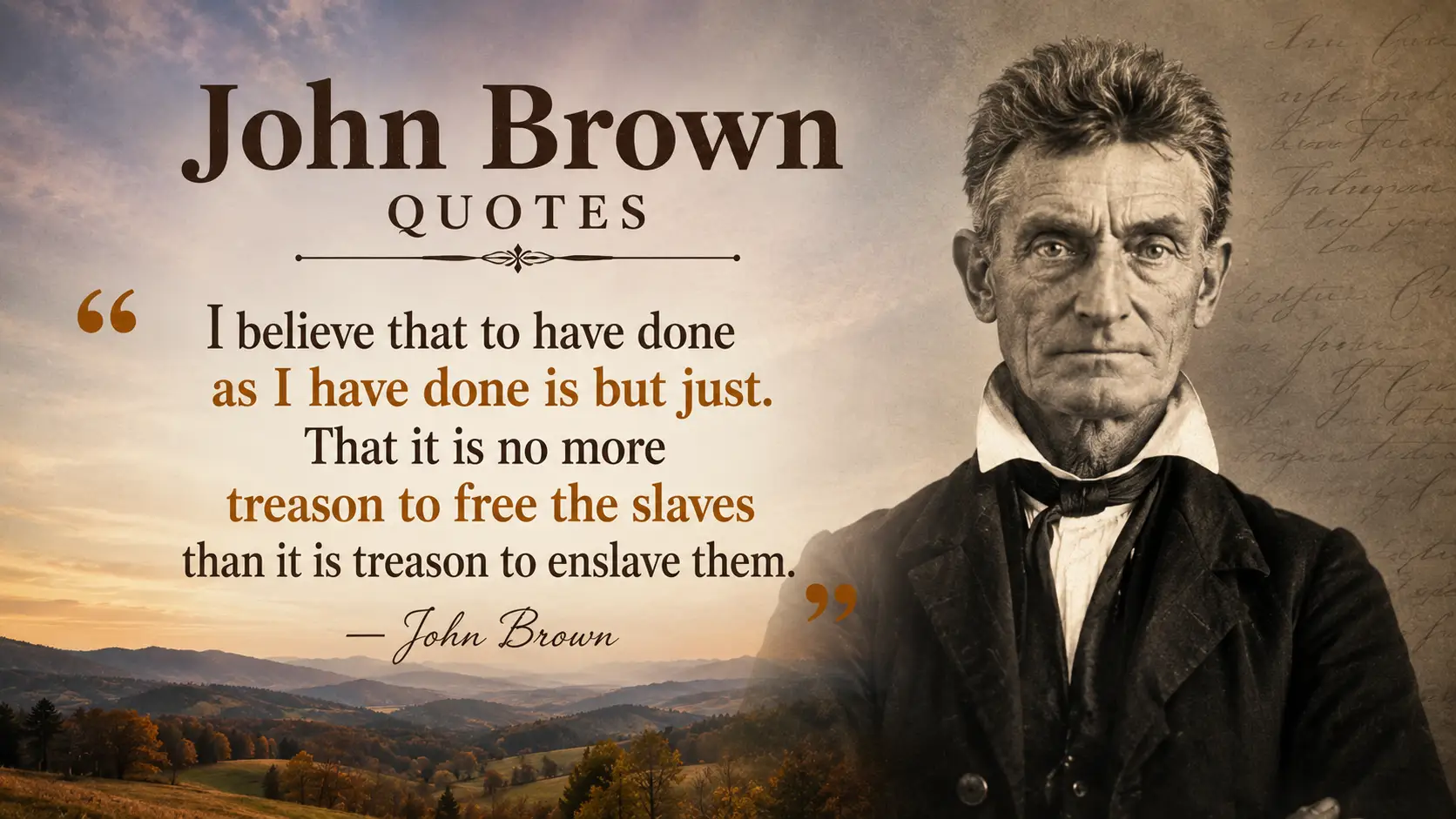
John Brown spoke words that people have been arguing about for more than 160 years. That is not a coincidence. The man himself was an argument — a contradiction of his era’s comfortable moral compromises, a person so committed to the abolition of slavery that he was willing to use violence when others were still organizing petition drives. To some he was a hero and a prophet. To others he was a fanatic who brought the nation closer to war with the blood of people who may have been guilty of nothing more than living in the wrong place at the wrong time. The arguments about John Brown have never fully resolved. His words remain at the center of them.
I have spent years studying American abolitionist history, the ideology of moral extremism in the service of just causes, and the rhetoric of the antebellum period. What I know is this: John Brown’s quotes are some of the most striking in American history — not because of their literary grace but because of the directness with which he said what most people of his era were not willing to say, and because of the moral challenge they still present to anyone who reads them honestly. This complete John Brown quotes collection — organized by theme, with historical context and sourcing — was built for every student, researcher, and curious reader who wants to understand not just what he said but what he meant.
Who Was John Brown? — Brief Historical Context

John Brown (May 9, 1800 – December 2, 1859) was an American abolitionist who became one of the most controversial figures in American history. Born in Torrington, Connecticut, to a deeply religious anti-slavery family, Brown developed an absolute conviction from childhood that slavery was a moral crime against God and humanity — not merely a social ill to be reformed gradually but an active evil requiring active resistance.
His father operated a stop on the Underground Railroad, and Brown grew up in Hudson, Ohio, an abolitionist community. He married twice, fathered twenty children, and failed at numerous business ventures. What remained constant through every reversal was his commitment to the destruction of slavery.
Brown’s most significant actions included:
The Pottawatomie Massacre (May 1856) — In response to pro-slavery violence in Kansas, Brown and a small group killed five pro-slavery settlers at Pottawatomie Creek. The killings shocked the nation and made Brown a wanted man in the South.
The Harper’s Ferry Raid (October 16-18, 1859) — Brown led twenty-one men in a raid on the federal armory at Harper’s Ferry, Virginia, hoping to seize weapons and trigger a slave uprising. The raid failed. Brown was captured by forces under Colonel Robert E. Lee, tried for treason, murder, and conspiracy, and hanged on December 2, 1859.
His execution did not silence him. His final written words, his statements at trial, and the words spoken about him by figures like Frederick Douglass, Abraham Lincoln, and Ralph Waldo Emerson became some of the most quoted and debated words in American history. The Civil War began sixteen months after his hanging. Read more victoria day quotes.
John Brown’s Most Famous Quotes

These are the words most associated with John Brown — the statements that have been quoted, debated, and returned to across more than a century and a half of American history.
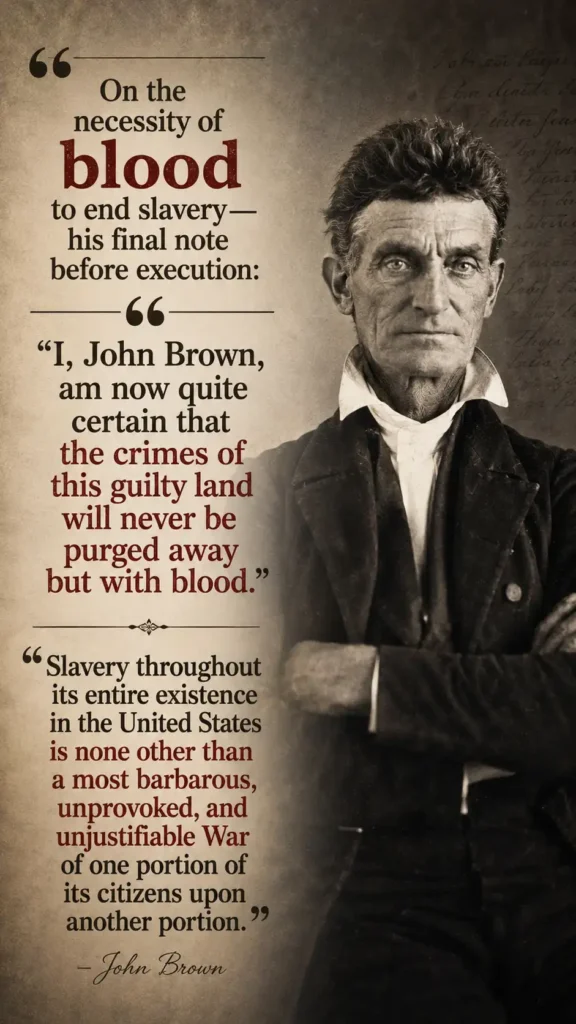
On the necessity of blood to end slavery — his final note before execution: “I, John Brown, am now quite certain that the crimes of this guilty land will never be purged away but with blood.”
On action over talk — at a New England Anti-Slavery Society meeting, 1859: “Talk! Talk! Talk! That will never free the slaves. What is needed is action — action!”
On why he raided Harper’s Ferry: “We came to free the slaves, and only that.”
At his sentencing — one of the most remarkable courtroom speeches in American history: “I believe that to have interfered as I have done — as I have always freely admitted I have done — in behalf of His despised poor, was not wrong, but right. Now, if it is deemed necessary that I should forfeit my life for the furtherance of the ends of justice, and mingle my blood further with the blood of my children and with the blood of millions in this slave country whose rights are disregarded by wicked, cruel, and unjust enactments — I submit; so let it be done!”
On slavery as war: “Slavery throughout its entire existence in the United States is none other than a most barbarous, unprovoked, and unjustifiable War of one portion of its citizens upon another portion.”
On his refusal to accept human authority over conscience: “I acknowledge no master in human form.”
On peace being impossible with slavery: “There will be no peace in this land until slavery is done for.”
On God’s impartiality: “I am yet too young to understand that God is any respecter of persons.” Explore more biblical quotes.
John Brown Quotes About Slavery
These quotes represent Brown’s core conviction — that slavery was not a political question to be negotiated but a moral crime to be destroyed.
“Slavery throughout its entire existence in the United States is none other than a most barbarous, unprovoked, and unjustifiable War of one portion of its citizens upon another portion.”
“There will be no peace in this land until slavery is done for.”
“I don’t think the people of the slave states will ever consider the subject of slavery in its true light till some other argument is resorted to other than moral persuasion.”
“Talk is a national institution, but it does not help the slave.”
“I have only a short time to live, only one death to die, and I will die fighting for this cause.”
“The way to break the chain of slavery is to break it — not to discuss it.”
“I saw slavery as a crime not against one man but against all men — and against God, who made them equal.”
“Moral suasion is hopeless. We need to take the battle to where the evil lives.”
“I have been whipped, as the saying is, but I am sure I can recover all the lost capital occasioned by that disaster; by only hanging a few moments by the neck; and I feel quite determined to make the utmost possible out of a defeat.”
“The crimes committed against the enslaved people of this country are crimes that will demand their payment — and payment will come.”
John Brown Quotes About Freedom and Justice

Brown’s understanding of freedom was not abstract — it was immediate, personal, and absolute.
“I believe that to have interfered as I have done in behalf of His despised poor was not wrong, but right.”
“We came to free the slaves, and only that.”
“I acknowledge no master in human form.”
“Freedom is not a gift that can be given by those who hold the chains. It must be seized.”
“The same eye cannot both look up to heaven and down to earth.” (On the impossibility of faith coexisting with the tolerance of slavery)
“I see a book kissed here which I suppose to be the Bible, or at least the New Testament. That teaches me that all things, whatsoever, I would that men should do to me, I should do even so to them. It teaches me further to ‘remember them that are in bonds, as bound with them.’ I endeavored to act up to that instruction.”
“What is right in the sight of God is the most important thing of all.”
“I have been told that I am wrong. I refer to the Bible which I endeavored to teach to others.”
“Here, before God, in the presence of these witnesses, from this time I consecrate my life to the destruction of slavery.”
“The ax is laid at the root of the tree, and the time is fast approaching when we must act.”
John Brown Quotes About God and Faith

Brown’s abolition was theological before it was political. His faith was the engine of everything he did.
“I am yet too young to understand that God is any respecter of persons.”
“I believe that to have interfered as I have done in behalf of His despised poor was not wrong, but right.”
“God has honored me with a task, and I will not shrink from it because the world calls it dangerous.”
“I see a book kissed here which I suppose to be the Bible. That teaches me to remember them that are in bonds, as bound with them.”
“In my youth I pledged eternal war with slavery. I have kept that pledge before God.”
“If it is deemed necessary that I should forfeit my life for the furtherance of the ends of justice, I submit; so let it be done.”
“God is no respecter of persons. The enslaved man is as much in His image as the man who holds the chain.”
“I did not come to Harper’s Ferry for myself. I came for the despised poor of this land. That cause is still alive, and it will live longer than I.”
“I am not a fanatic who has lost touch with God. I am a servant of God who has been touched by the cries of His people.”
“My religion teaches me that obedience to God must come before obedience to the laws of men when those laws are in opposition to God’s will.”
John Brown Quotes About Action
Brown’s most distinctive contribution to abolitionist thought was his insistence that talk was not enough — that the scale of the crime required the scale of the response.
“Talk! Talk! Talk! That will never free the slaves. What is needed is action — action!”
“Talk is a national institution, but it does not help the slave.”
“These men are all talk. What is needed is action — action!”
“I don’t think the people of the slave states will ever consider the subject of slavery in its true light till some other argument is resorted to other than moral persuasion.”
“The time for speeches is over. The time to act is now.”
“Every day we debate is a day lived in chains for someone who cannot afford our deliberation.”
“I have been acting against slavery my entire adult life. The question was never whether to act but how.”
“The peaceful method has had its chance. It has not freed one person. We must try another method.”
“History will not record that we spoke eloquently about slavery. It will record whether we ended it.”
“Delay is not neutrality. Every year of debate is another year of slavery. I am not willing to wait.”
John Brown’s Sentencing Speech — November 2, 1859
This is one of the most significant speeches in American history — delivered immediately after Brown was sentenced to death. It is quoted here in summary form with key passages.
After being sentenced to hang, Brown addressed the court directly. He rejected the characterization that he had done wrong, maintained that his reading of the Bible’s Golden Rule — do unto others as you would have them do to you — required him to act for the enslaved as he would wish others to act for him. He declared that he believed interference on behalf of the oppressed was right, not wrong. He expressed no desire to live if living required him to accept the continuing existence of slavery. And he said, with the composure that astonished his captors and the court: “If it is deemed necessary that I should forfeit my life for the furtherance of the ends of justice… I submit; so let it be done.”
Frederick Douglass later wrote that Brown’s composure at his sentencing and execution did more for the abolitionist cause than a dozen of his raids could have.
Key lines from the sentencing speech:
“I feel entirely satisfied with the treatment I have received on my trial. Considering all the circumstances, it has been more generous than I expected.”
“I have no counsel. I did not ask to have counsel appointed for me. I know that anything further said by me will be of but little avail.”
“I believe that to have interfered as I have done in behalf of His despised poor was not wrong, but right.”
“Now, if it is deemed necessary that I should forfeit my life for the furtherance of the ends of justice, and mingle my blood further with the blood of my children and with the blood of millions in this slave country — I submit; so let it be done!”
John Brown Quotes in His Final Days
The weeks between his capture (October 18, 1859) and his execution (December 2, 1859) produced some of Brown’s most quoted words — written in letters and spoken to visitors.
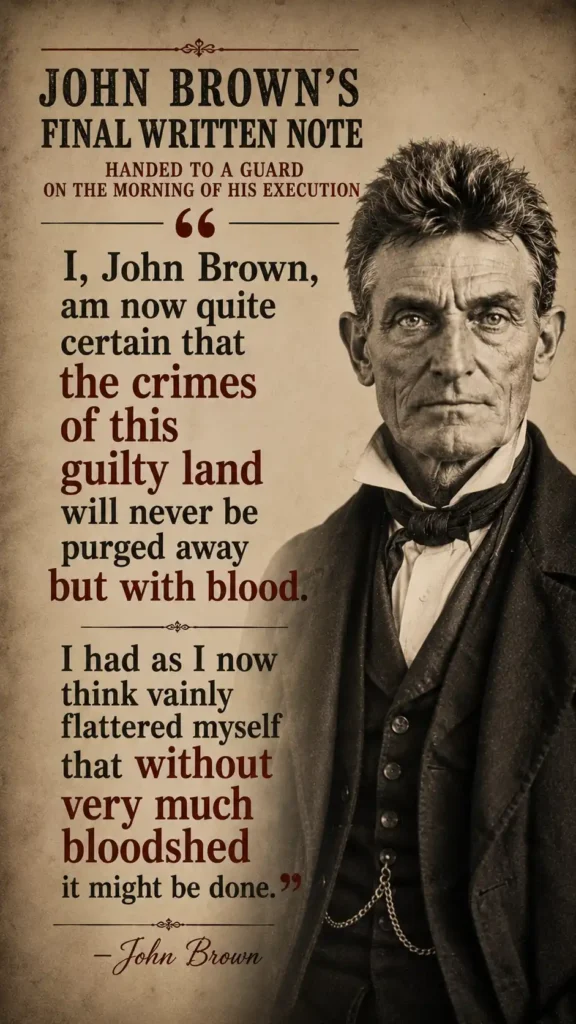
His final written note, handed to a guard on the morning of his execution: “I, John Brown, am now quite certain that the crimes of this guilty land will never be purged away but with blood. I had as I now think vainly flattered myself that without very much bloodshed it might be done.”
On his approaching death: “I am gaining in health slowly and am quite cheerful in view of my approaching end.”
On his execution being more valuable than his survival: “I am worth inconceivably more to hang than for any other purpose.”
On the beauty of the land as he rode to his execution: “This is a beautiful country.”
On his willingness to die: “I have only a short time to live, only one death to die, and I will die fighting for this cause.”
To his wife Mary, in a letter before execution: “I am still gaining in strength though slowly. I may perhaps yet live to see you once more. But my chances are not good.”
On facing death with peace: “I have been whipped as the saying is, but I am sure I can recover all the lost capital occasioned by that disaster; by only hanging a few moments by the neck.”
John Brown Quotes From His Letters and Writings
Brown was a prolific letter writer — and his private correspondence reveals the same convictions he expressed publicly, with added personal dimension.
From a letter to Henry Stearns about his childhood — 1857: “During the war with England a circumstance occurred that in the end made him a most determined Abolitionist and led him to declare, or Swear: Eternal war with Slavery.”
From his essay “Sambo’s Mistakes” — 1847: “Another trifling error of my life has been that I have always expected to secure the favour of the whites by tamely submitting to every species of indignity contempt and wrong instead of nobly resisting their brutal aggressions from principle and taking my place as a man.”
On his personal conduct: “Be mild with the mild, shrewd with the crafty, confiding to the honest, rough to the ruffian, and a thunderbolt to the liar. But in all this, never be unmindful of your own dignity.”
On the necessity of his cause: “I have no other master. My life belongs to this work.”
On the Underground Railroad and his work: “I will have nothing to do with so mean an act. I would sooner take my gun and help drive you out of the country.”
On preparing for Harper’s Ferry: “We are all ready. I will not say what I intend to do. But I intend to act.”
What Others Said About John Brown
John Brown’s contemporaries disagreed profoundly about him — and their words about him are as revealing as his own.
Abraham Lincoln — on Brown’s execution: Lincoln took a careful middle position: “We cannot object, even though he agreed with us in thinking slavery wrong. That cannot excuse violence, bloodshed, and treason.” But Lincoln also acknowledged the moral force of Brown’s position.
Frederick Douglass — in a speech at Storer College, 1881: Douglass, who had declined to join the Harper’s Ferry raid but remained connected to Brown, said: “His zeal in the cause of my race was far greater than mine — it was as the burning sun to my taper light — mine was bounded by time, his stretched away to the boundless shores of eternity.”
Ralph Waldo Emerson — on Brown after his capture: Emerson called Brown “that new saint, than whom none purer or more brave was ever led by love of men into conflict and death — the new saint awaiting his martyrdom, and who, if he shall suffer, will make the gallows glorious like the cross.”
Henry David Thoreau — “A Plea for Captain John Brown,” 1859: Thoreau delivered one of the most passionate defenses of Brown before his execution: “No man in America has ever stood up so persistently and effectively for the dignity of human nature, knowing himself for a man, and the equal of any and all governments.”
Herman Melville — “The Portent” (poem, 1866): Melville called Brown “the meteor of the war” — acknowledging him as both omen and catalyst for the Civil War that followed.
Victor Hugo — from exile in Guernsey: Hugo wrote an open letter condemning Brown’s execution, predicting that Brown would be remembered as a martyr: “Politically speaking, the murder of Brown would be an irreparable fault. It would penetrate the Union with a secret fissure, which would in the end tear it asunder.”
John Brown’s Legacy — The Debate That Continues
John Brown remains one of the most contested figures in American history — precisely because the questions his life raises have not been resolved.
The case for Brown as hero and martyr: Brown saw with absolute clarity what many of his contemporaries refused to see — that slavery was not a political negotiation but a moral catastrophe, and that it would not end without violence because those who benefited from it would not surrender it voluntarily. The Civil War, which began sixteen months after his execution, vindicated the core of his analysis even as it condemned his methods. Frederick Douglass’s assessment stands as one of the most powerful: Brown’s commitment to Black freedom exceeded that of virtually any white person of his era.
The case for Brown as fanatic: Brown’s actions at Pottawatomie — the killing of five men, including one seventeen-year-old, who had not been directly involved in violence against abolitionists — are difficult to defend on any grounds. The Harper’s Ferry raid was tactically disastrous and may have accelerated the very war Brown hoped to trigger without producing any of the slave uprising he anticipated. His certainty that God had chosen him for this mission is characteristic of the zealot who does not permit moral doubt.
What the quotes reveal: Read together, Brown’s quotes reveal a man of absolute moral conviction, genuine religious faith, intellectual consistency, tactical inflexibility, and almost no capacity for self-doubt. He was not a complex man in the usual sense — he was a simple man in the most demanding sense: he held one belief with total consistency and accepted every consequence of holding it.
FAQs About John Brown Quotes
What is John Brown’s most famous quote?
His most famous quote is his final written note before execution: “I, John Brown, am now quite certain that the crimes of this guilty land will never be purged away but with blood.” This statement, written on December 2, 1859, the morning of his hanging, encapsulates his entire worldview.
What did John Brown say about slavery?
Brown’s core statement on slavery: “Slavery throughout its entire existence in the United States is none other than a most barbarous, unprovoked, and unjustifiable War of one portion of its citizens upon another portion.” He consistently viewed slavery not as an economic system or a social institution but as an active ongoing war crime.
What did John Brown say at his sentencing?
At his sentencing on November 2, 1859, Brown delivered one of American history’s most remarkable courtroom statements, concluding: “If it is deemed necessary that I should forfeit my life for the furtherance of the ends of justice, and mingle my blood further with the blood of millions in this slave country whose rights are disregarded by wicked, cruel, and unjust enactments — I submit; so let it be done!”
What did John Brown say about talk versus action?
Brown was contemptuous of the abolitionist reliance on moral persuasion and rhetoric: “Talk! Talk! Talk! That will never free the slaves. What is needed is action — action!” He also said: “Talk is a national institution, but it does not help the slave.”
What did John Brown say on the day of his execution?
On December 2, 1859, as he was led to the gallows, Brown handed a guard his final written note containing his certainty that “the crimes of this guilty land will never be purged away but with blood.” He also reportedly observed: “This is a beautiful country” — looking at the Virginia countryside on the way to his execution.
What did Frederick Douglass say about John Brown?
Douglass said: “His zeal in the cause of my race was far greater than mine — it was as the burning sun to my taper light — mine was bounded by time, his stretched away to the boundless shores of eternity.” He also noted that Brown had given more to the cause of Black freedom than virtually any white American of his time.
What did Ralph Waldo Emerson say about John Brown?
Emerson called Brown “that new saint, than whom none purer or more brave was ever led by love of men into conflict and death” and predicted his execution would “make the gallows glorious like the cross.”
Was John Brown a hero or a villain?
Brown remains one of the most contested figures in American history. To abolitionists, Black Americans, and many historians he is a hero who saw clearly what others refused to see and acted when others merely talked. To others he is a violent extremist whose methods cannot be justified regardless of the cause. See the legacy section above for a fuller treatment of both perspectives.
What was John Brown’s view of God and religion?
Brown’s abolitionism was fundamentally theological. He believed slavery was a sin against God, that God did not favor one race over another (“I am yet too young to understand that God is any respecter of persons”), and that his actions were divinely ordained. His faith was the source of both his conviction and his willingness to die.
When and where did John Brown die?
John Brown was hanged on December 2, 1859, at Charles Town, Virginia (now West Virginia), following his conviction for treason, murder, and conspiring with slaves to rebel. He was 59 years old. The Civil War began in April 1861 — sixteen months later.
Final Thoughts
John Brown’s quotes do not offer comfort. They do not invite agreement without cost. They are the words of a man who looked at one of the defining moral questions of American history and refused every accommodation, every delay, every compromise. They are the words of someone who believed that the moral emergency of slavery required the moral emergency of action — and who was willing to pay with his life for that belief.
What makes these quotes endure is not that Brown was right about everything. He was not. What makes them endure is that he named something his era was not willing to name — that the tolerance of slavery by a nation that called itself free was a contradiction that would eventually demand a violent resolution. He was hanged in December 1859. The Civil War began in April 1861. His last note, predicting that the crimes of the guilty land would never be purged away but with blood, proved to be among the most prophetic words written in the antebellum period.
These John Brown quotes were gathered with that history in mind — not to celebrate or condemn but to present, with context, the words of a man whose life and death remain among the most morally complex and historically significant in American history.
“I, John Brown, am now quite certain that the crimes of this guilty land will never be purged away but with blood.” — December 2, 1859, the morning of his execution.
